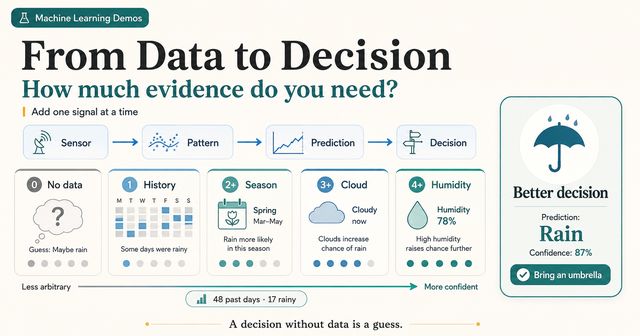
From Data to Decision
Start with zero data — just a coin flip — then add one signal at a time (season, cloud cover, humidity) to the same 48 days and watch prediction accuracy climb.
01204563 Advanced Machine Learning
Small interactive demonstrations for explaining machine-learning concepts in class. More demos will be added here over time.
Chapter 1 · From Data to Decisions
Start with zero data — just a coin flip — then add one signal at a time (season, cloud cover, humidity) to the same 48 days and watch prediction accuracy climb.
Chapter 2 · Inside a Learning System
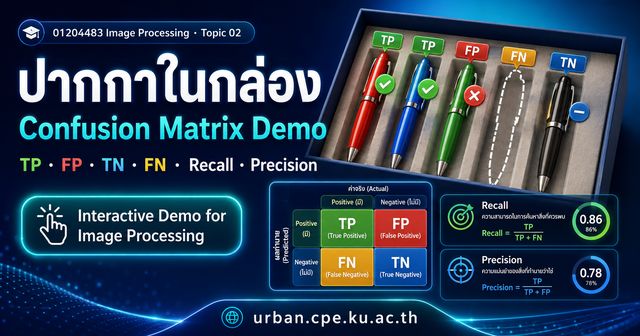
Build a small dataset, choose a query, then click what's actually true and watch TP/FP/TN/FN, recall, and precision compute live.
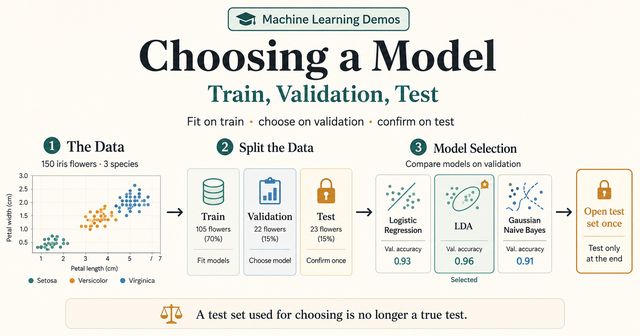
150 iris flowers split into train/validation/test before any model is fit — three named model families compete on validation only, and the test set opens once, at the end.
Chapter 3 · Reasoning from Evidence
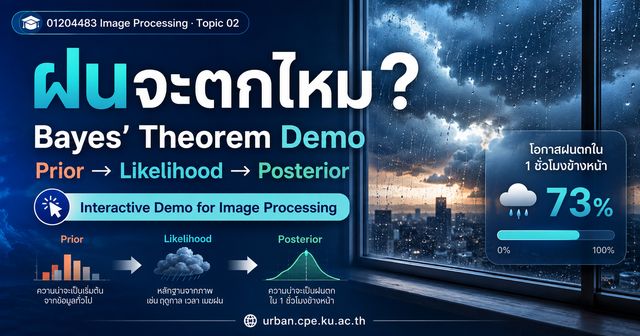
Reveal evidence one piece at a time — season, time of day, cloud cover — and watch prior × likelihood combine into a posterior, live.
Chapter 4 · Learning from Nearby Examples
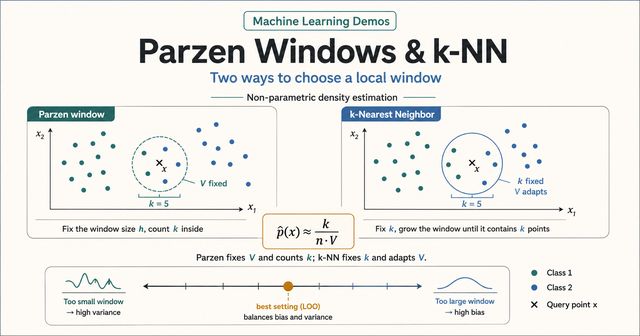
Compare two ways to pick a local window for classification, and use a leave-one-out accuracy curve to see why the window size matters.

Not from this book, but the same bandwidth idea one level down: see exactly what's lost from spatial sampling and intensity quantization, with Nyquist-limit and aliasing presets.
Chapter 5 · Learning Decision Boundaries
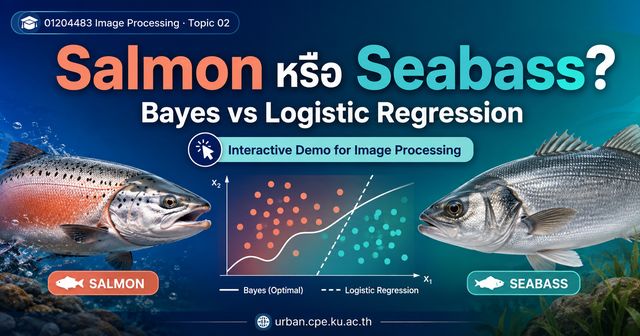
Sample from a real population and classify it with naive Bayes and logistic regression, then compare each fitted boundary against the true population boundary.
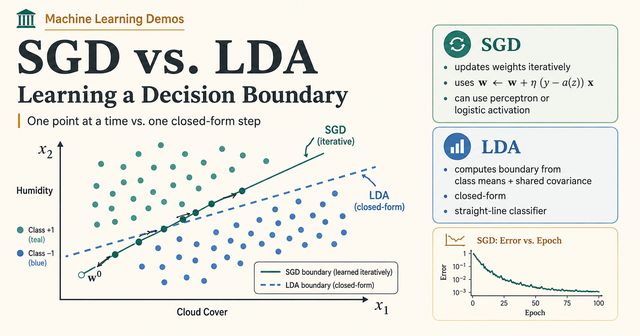
Step through the exact arithmetic of training a linear classifier one point at a time — pick perceptron or logistic activation — and watch it chase LDA's closed-form boundary.
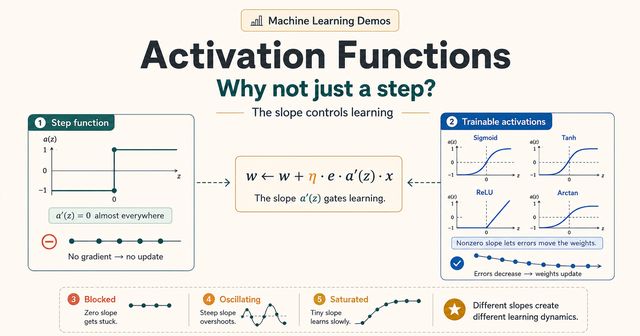
Sigmoid, tanh, arctan, ReLU, step, and linear all race on the same data, same steepness, same learning rate — watch Step's error sit dead flat at 50% while its slope stays zero.
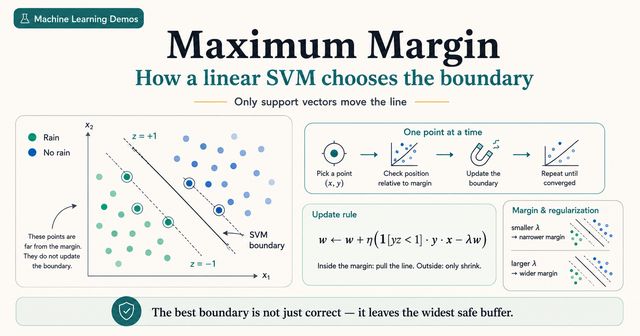
Same rain data as SGD vs. LDA — step through a soft-margin SVM update and watch which points are support vectors, then raise λ to widen the margin and shrink that set.
Chapter 7 · Neural Networks
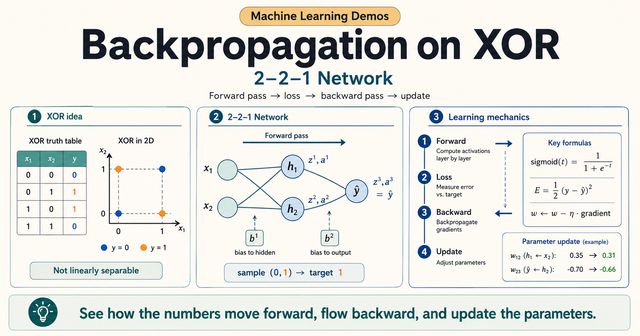
A step-by-step 2–2–1 MLP demonstration. Follow the numbers through the forward pass, loss, backward pass, and parameter update.
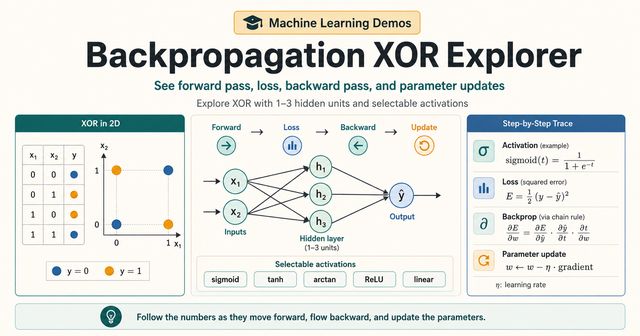
Experimental version with 1–3 hidden units and selectable activation functions: sigmoid, tanh, arctan, ReLU, and linear.
Chapter 8 · Deep Learning
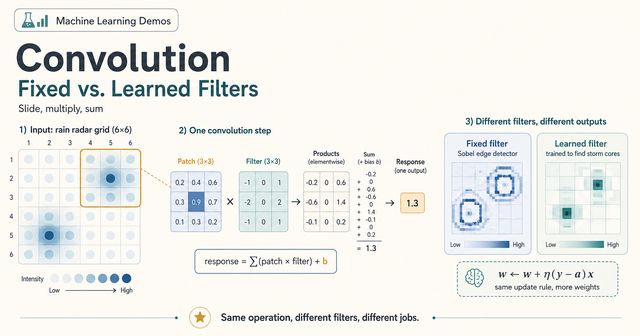
Slide a 3×3 filter by hand on a rain-radar grid before the word "convolution" ever comes up, then compare a hand-designed edge filter against one trained with plain gradient descent.
Chapter 9 · Large Language Models
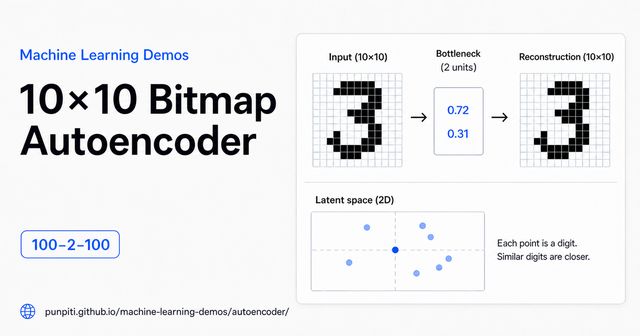
Train a 100–h–100 autoencoder on digits or bitmap icons, inspect every hidden feature, draw a test input, and compare its reconstruction with the closest training template.
Chapter 10 · Learning with Trees
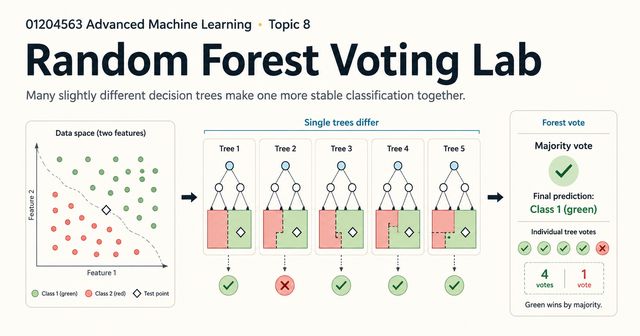
Grow a small random forest, inspect bootstrap samples and random feature splits, then see how individual decision trees vote together.
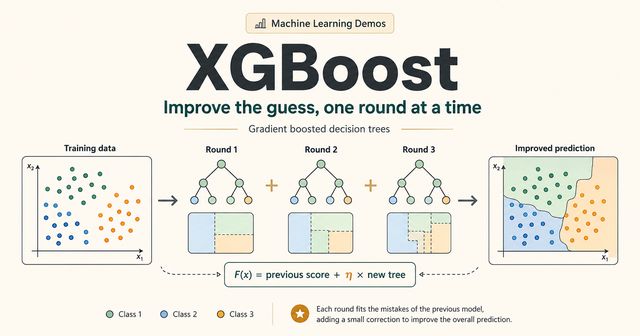
Build a small multi-class gradient-boosted model round by round, watching one tree per class correct the softmax residuals left by the last round.